How Malaysia Implemented e-Invoicing and What Sri Lanka Can Learn
Jun 02, 2026
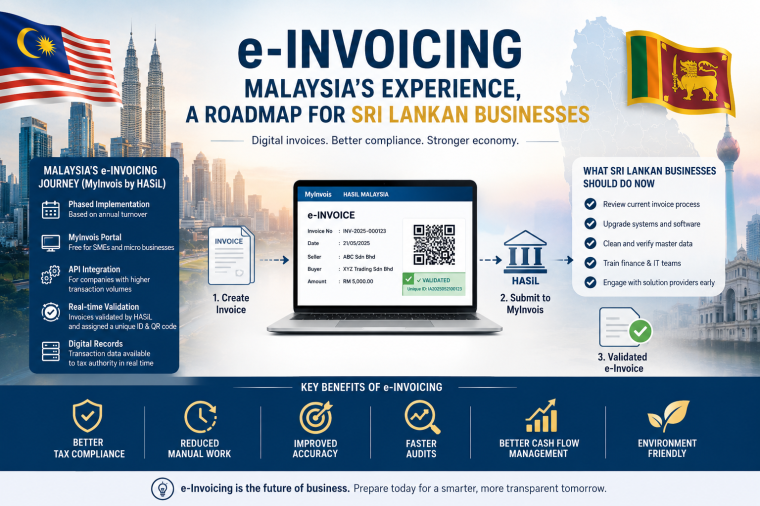
Many Sri Lankan businesses are currently discussing the proposed National e-Invoicing System and how it will impact their operations. To understand what may lie ahead, it is useful to examine how Malaysia successfully implemented its e-Invoicing system through the Inland Revenue Board of Malaysia (LHDN) using the MyInvois Platform. Malaysia's experience provides valuable lessons for businesses, software providers, accountants, and tax professionals in Sri Lanka.
Why Did Malaysia Introduce e-Invoicing?
Malaysia introduced e-Invoicing as part of its broader digital transformation strategy to:
- Improve tax compliance.
- Reduce tax evasion and under-reporting.
- Increase transparency in business transactions.
- Reduce manual paperwork.
- Enable real-time access to transaction data for tax administration.
- Promote a digital business ecosystem.
Rather than treating e-Invoicing as a tax project, Malaysia positioned it as a national digitalization initiative involving businesses, accountants, software vendors, and government agencies.
Malaysia Did Not Implement It Overnight
One of the biggest reasons for Malaysia's success was its phased implementation approach.
The Inland Revenue Board introduced the system gradually based on annual turnover:
| Implementation Date | Annual Turnover |
|---|---|
| 1 August 2024 | Above RM 100 Million |
| 1 January 2025 | RM 25 Million – RM 100 Million |
| 1 July 2025 | RM 5 Million – RM 25 Million |
| 2026 onwards | Smaller businesses and SMEs in phases |
This approach gave businesses sufficient time to upgrade systems, train staff, and resolve implementation issues before smaller businesses joined the system.
How the Malaysian e-Invoice System Works
Under Malaysia's model, an invoice is no longer simply created and sent to a customer.
Instead:
- Seller creates the invoice.
- Invoice is transmitted electronically to the MyInvois platform.
- The tax authority validates the invoice.
- A unique validation ID and QR code are generated.
- The validated invoice is shared with the customer.
- The transaction becomes part of the tax authority's digital records.
This means tax authorities receive transaction information almost in real time rather than waiting for VAT returns or annual tax filings.
Multiple Submission Methods Were Provided
Malaysia recognized that not all businesses possess sophisticated ERP systems.
Therefore, two methods were provided:
1. MyInvois Portal
A free government portal for small and medium businesses with lower transaction volumes.
2. API Integration
For larger businesses, accounting systems and ERP software could connect directly to MyInvois through APIs, allowing invoices to be submitted automatically.
This prevented SMEs from being disadvantaged while allowing larger organizations to automate the entire process.
Benefits Experienced by Malaysian Businesses
Better Tax Compliance
Since invoice data is submitted directly to the tax authority, opportunities for under-reporting sales and claiming fictitious expenses are significantly reduced.
Reduced Manual Work
Businesses spend less time on manual invoice preparation, filing, and reconciliation. Many processes become automated.
Improved Accuracy
Automated data transfer reduces human errors, duplicate entries, and invoice mismatches.
Faster Audits
Tax audits become more efficient because transaction records are already available digitally.
Better Cash Flow Management
Businesses can track invoices and payments more effectively through integrated systems, improving financial visibility.
Reduced Paper Usage
Printing, storage, and document management costs are reduced significantly.
Challenges Faced During Implementation
Malaysia's journey was not without difficulties.
Some common challenges included:
- Upgrading accounting software.
- ERP integration costs.
- Staff training requirements.
- Data quality issues.
- Changes to internal processes.
- Readiness concerns among SMEs.
Recognizing these challenges, the authorities provided transition periods, technical guidance, and relaxation periods during the early phases of implementation.
What Sri Lankan Businesses Should Do Now
Although Sri Lanka's implementation approach may differ, businesses should begin preparing immediately.
Review Your Current Invoice Process
Determine whether your current invoice format captures all information likely to be required under a digital invoicing system.
Upgrade Accounting Systems
Ensure your accounting software can:
- Generate structured invoice data.
- Support API integration.
- Produce electronic invoice records.
Clean Your Customer Data
Many businesses maintain incomplete customer records. Accurate customer information will become increasingly important under e-Invoicing.
Train Finance and IT Teams
e-Invoicing is not purely an accounting project. It requires coordination between finance, tax, operations, and IT departments.
Engage Software Providers Early
ERP vendors, accounting software providers, and developers should start reviewing potential integration requirements now rather than waiting for mandatory implementation.
Conclusion
Malaysia's experience demonstrates that e-Invoicing is much more than replacing paper invoices with PDFs. It is a complete transformation of how businesses report transactions and how tax authorities monitor compliance. Through phased implementation, strong digital infrastructure, free portals for SMEs, and API connectivity for larger businesses, Malaysia has created a framework that improves compliance while modernizing business operations.
As Sri Lanka moves toward its own e-Invoicing framework, businesses that prepare early by upgrading systems, improving data quality, and understanding digital compliance requirements will be in a much stronger position when the system becomes mandatory.