Fiscal Challenges and Strategic Priorities for Budget 2027
Jul 02, 2026 - 03:00 pm
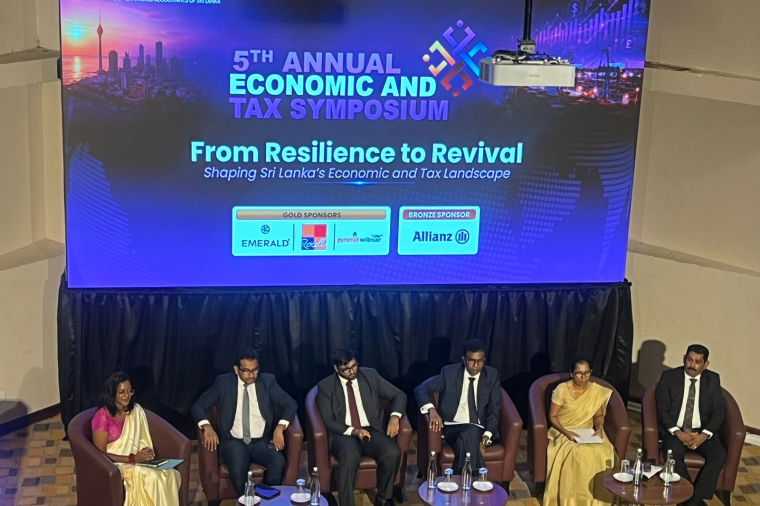
The fifth symposium brought together senior officials from the Inland Revenue Department (IRD), the Ministry of Finance, economists, tax practitioners, and private sector leaders to discuss one of the most important policy questions facing Sri Lanka: How should the country's tax system evolve beyond economic stabilization toward sustainable growth?
The panel discussion focused on the fiscal priorities for Budget 2027, examining tax policy, revenue mobilization, investment competitiveness, fiscal resilience, debt sustainability, and the future direction of Sri Lanka's tax administration.
Moving Beyond GDP: What Should Sri Lanka Really Be Measuring?
Raj Prabu Rajakulendran – Lead Economist, Verité Research
Raj Prabu Rajakulendran challenged the traditional emphasis on GDP growth, arguing that economic growth should be viewed as a means rather than the ultimate objective of economic policy.
He explained that countries can experience GDP growth while simultaneously facing:
- Rising income inequality
- Job losses
- Increasing poverty
- Weak household welfare
Therefore, Sri Lanka should evaluate its success using broader indicators including:
- Poverty reduction
- Income inequality (such as the Gini Coefficient)
- Employment generation
- Household wellbeing
- Economic resilience
According to him, fiscal policy should ultimately improve people's lives rather than simply produce higher GDP figures.
Fiscal Resilience Requires More Than Revenue Growth
Raj Prabu identified three essential pillars of fiscal resilience.
1. Real Economy Resilience
Economic policies should prioritise:
- Sustainable employment
- Reduction of poverty
- Inclusive growth
- Improved living standards
instead of focusing solely on headline GDP numbers.
2. Fiscal Resilience
Maintaining healthy government finances requires:
- Sustainable revenue collection
- Prudent expenditure management
- Strong fiscal buffers
rather than relying solely on higher taxation.
3. Debt and Monetary Resilience
He noted that Sri Lanka's future challenges extend beyond tax collection.
Critical questions include:
- Is the country borrowing sustainably?
- Can future debt repayments after 2030 be comfortably met?
- Are sufficient fiscal buffers being built?
He emphasised the importance of adopting a professional medium-term debt management strategy that anticipates future shocks.
Predictability Matters More Than Tax Rates
Addressing the impact of taxation on investment, Raj Prabu made an important distinction.
He observed that international investor surveys consistently show that:
Investors are generally more concerned about unpredictable tax policy than about relatively high tax rates.
Frequent policy reversals create uncertainty and discourage investment.
His recommendation was therefore:
- Maintain policy consistency
- Avoid sudden tax changes
- Improve predictability of the tax system
rather than focusing solely on reducing tax rates.
Cost-Reflective Pricing Should Not Reward Inefficiency
Raj Prabu also discussed State-Owned Enterprises including:
- Ceylon Petroleum Corporation (CPC)
- Ceylon Electricity Board (CEB)
- SriLankan Airlines
He argued that:
- CPC's historical losses were driven largely by debt servicing and exchange rate movements rather than fuel pricing.
- CEB's financial difficulties arise primarily from generation costs and poor long-term planning.
- Formula pricing should rely on internationally recognised benchmark prices rather than inefficient procurement costs.
Passing inefficient purchasing decisions directly onto consumers, he noted, undermines public confidence.
From Fiscal Stability to Economic Transformation
Thanuja Perera – Tax Policy Advisor, Ministry of Finance
Representing the Ministry of Finance, Thanuja Perera explained that Sri Lanka has largely completed the first phase of post-crisis fiscal stabilisation.
The next challenge is economic transformation.
She stated that modern tax policy should aim to:
- Improve investor confidence
- Enhance competitiveness
- Encourage entrepreneurship
- Support long-term economic growth
rather than merely financing government expenditure.
Revenue Targets Will Continue—Without Raising Tax Rates
The Ministry intends to maintain:
- Government revenue above 15% of GDP
- Primary surplus around 2.6% of GDP
However, Thanuja emphasised that these objectives will primarily be achieved through:
- Expanding the tax base
- Improving taxpayer compliance
- Digital transformation
- Better information sharing
rather than increasing existing tax rates.
Broadening the Tax Base
According to the Ministry, one of Sri Lanka's biggest challenges remains low tax compliance.
Large numbers of liable taxpayers remain outside the formal tax system.
Future reforms therefore focus on:
- Sharing information among government agencies
- Integration between Customs, Excise and IRD
- Data exchange with banks and other institutions
- Advanced analytics
- Artificial Intelligence
- Digital tax administration
The objective is to collect taxes from all liable taxpayers while reducing the burden on compliant taxpayers.
Why the VAT Threshold Was Postponed
Thanuja also addressed questions regarding the postponement of the proposed VAT registration threshold reduction.
She explained that:
- Numerous SME stakeholders requested additional time.
- Compliance costs remained a significant concern.
- The postponement was intended to allow businesses to prepare.
She further noted that the IMF programme focuses primarily on achieving agreed revenue targets rather than prescribing specific tax measures, giving the Government flexibility in selecting the most appropriate policy instruments.
High Taxes Still Matter
Nandika Buddhipala – Executive Independent Director, Sarvodaya Development Finance PLC
Nandika Buddhipala acknowledged the importance of fiscal consolidation but cautioned against excessive dependence on indirect taxation.
His observations included:
- Higher indirect taxes disproportionately affect lower-income households.
- Inflation and reduced purchasing power make additional indirect taxes more burdensome.
- Tax policy should balance revenue generation with social equity.
He also highlighted Sri Lanka's long-standing challenges in attracting foreign direct investment and improving the ease of doing business.
Global Tax Changes Create New Opportunities
Sulaiman Nishtar – Partner & Head of Tax, EY Sri Lanka & Maldives
Sulaiman focused on major international tax developments, particularly the OECD's BEPS Pillar Two initiative.
He explained that multinational enterprises are increasingly subject to a global minimum effective tax rate of 15%.
This presents Sri Lanka with both opportunities and challenges.
If Sri Lanka grants tax holidays below the global minimum rate:
- multinational groups may simply pay the difference in another jurisdiction;
therefore,
- Sri Lanka may be better positioned to collect that revenue itself.
He suggested that Sri Lanka should carefully evaluate whether existing investment incentives remain effective under the new global tax landscape.
Emerging Opportunities Beyond Traditional Taxation
Sulaiman also highlighted several areas where Sri Lanka could expand future revenue generation.
These include:
- Carbon credit markets
- Biodiversity conservation financing
- Renewable energy investments
- Improved utilisation of data resources
- Better use of international tax standards
He noted that conservation itself can become an economically valuable asset.
Strengthening the Entire Tax Ecosystem
Saman Dissanayake – Commissioner (LTO Finance), Inland Revenue Department
Drawing upon both operational experience and statistical analysis, Saman Dissanayake explained that tax administration involves far more than revenue collection.
He described taxation as an interconnected ecosystem involving:
- Tax legislators
- Tax administrators
- Tax agents
- Taxpayers
- Tax adjudicators
- Tax informants
According to him, every stakeholder influences the effectiveness of the tax system.
Information Sharing Remains One of the Biggest Challenges
Although legislation now permits greater information exchange, practical implementation still faces obstacles.
He observed that several public institutions remain slow in sharing taxpayer information with the Inland Revenue Department.
Improving this cooperation, together with stronger digital integration, remains essential for future compliance improvements.
Sri Lanka's Tax Performance Has Improved Significantly
Using historical data, Saman illustrated the country's recovery in tax performance.
Key observations included:
- Tax revenue as a percentage of GDP has recovered strongly following the economic crisis.
- IRD revenue has reached historic highs.
- Revenue collection exceeded the 2025 target.
According to the 2025 performance figures presented:
- Revenue Target: Rs. 3,093 billion
- Revenue Collected: Rs. 3,221 billion
- Target Achievement: 104.41%
- Excess Collection: Approximately Rs. 128 billion
He also highlighted that in 2025:
- VAT contributed approximately 54% of IRD revenue.
- Income Tax contributed approximately 35%.
Recovering Outstanding Tax Debt
Responding to audience questions regarding collectible tax arrears, Saman explained that legislative amendments have already been proposed to improve the treatment of long-outstanding tax balances.
He noted that further refinements to debt recovery mechanisms are expected as the administration continues modernising tax enforcement.
Key Takeaways from the Panel Discussion
The discussion demonstrated broad consensus that Sri Lanka's tax system is entering a new phase.
While fiscal stabilisation remains important, future reforms must increasingly focus on:
- expanding the tax base rather than increasing tax rates;
- strengthening taxpayer compliance through digitalisation and information sharing;
- maintaining policy consistency to improve investor confidence;
- adopting internationally competitive tax policies in response to global developments such as BEPS Pillar Two;
- balancing revenue mobilisation with economic growth, competitiveness and social equity; and
- ensuring that fiscal policy ultimately improves living standards rather than merely achieving revenue targets.
As Sri Lanka prepares for Budget 2027, the panel emphasised that the country's next stage of reform should move beyond crisis management toward building a tax system that is predictable, technology-driven, equitable and supportive of sustainable long-term economic growth.