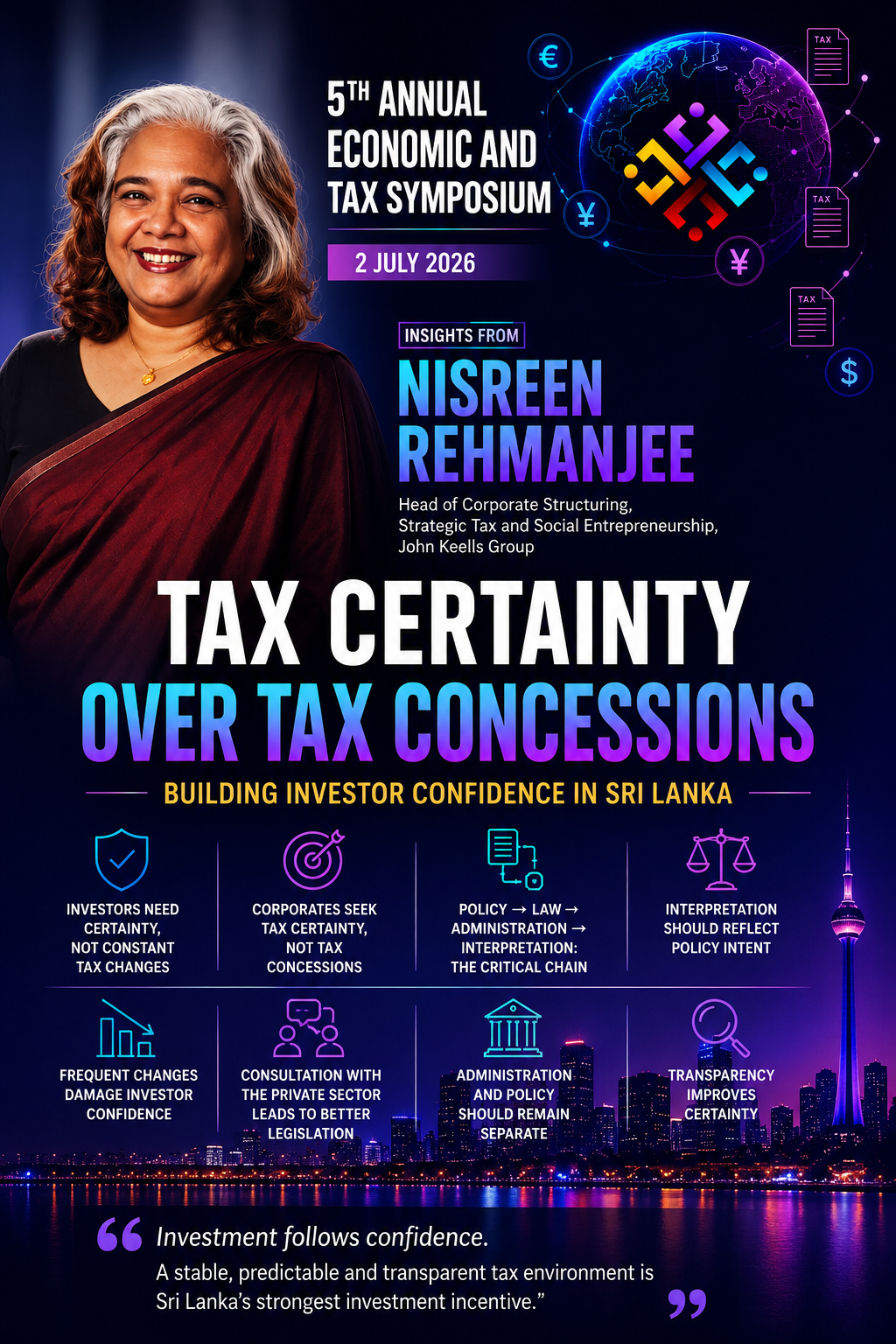
Tax Certainty Over Tax Concessions: Nisreen Rehmanjee's Perspective on Building Investor Confidence in Sri Lanka
Jul 04, 2026
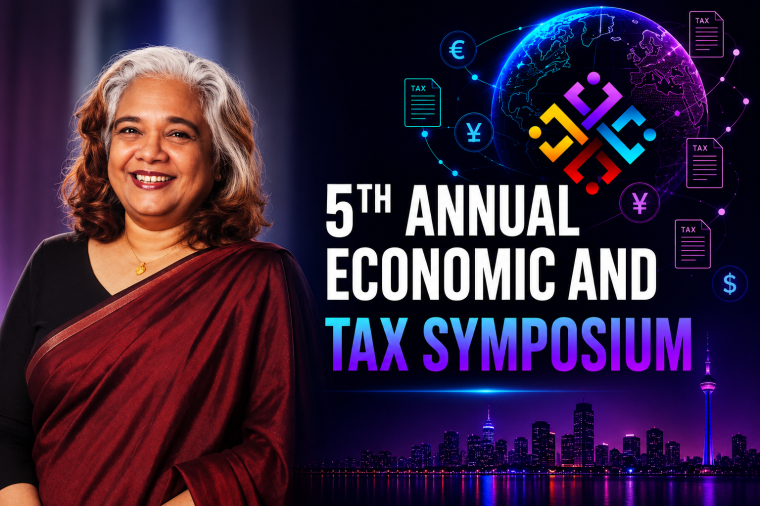
The 5th Annual Economic and Tax Symposium, held on 2 July 2026 and organised by the Faculty of Taxation of the Institute of Chartered Accountants of Sri Lanka (CA Sri Lanka), brought together leading professionals to discuss how Sri Lanka's tax system can better support long-term economic growth.
During the panel discussion on "Enhancing Tax System Efficiency to Support Economic Growth," Ms. Nisreen Rehmanjee, Head of Corporate Structuring, Strategic Tax and Social Entrepreneurship at John Keells Group, shared the corporate sector's perspective on one of the most important factors influencing investment decisions—tax certainty.
Drawing on her experience working with large corporate investments and international investors, Ms. Rehmanjee explained that while tax rates and incentives often receive significant attention, investors place even greater importance on consistency, predictability and confidence in the tax system.
Her remarks highlighted that sustainable investment is built not merely on favourable tax policies but on a tax environment that businesses can trust.
Investors Need Certainty More Than Tax Incentives
One of the strongest messages shared by Ms. Rehmanjee was that businesses are not constantly searching for new tax concessions.
Instead, they seek certainty.
Long-term investment decisions require businesses to forecast cash flows, returns on investment, financing costs and profitability over many years. These projections are only meaningful when the underlying tax environment remains reasonably stable.
When tax legislation changes frequently or administrative interpretations evolve unexpectedly, businesses are forced to incorporate significant uncertainty into their financial models. As a result, potentially viable investment opportunities may no longer appear commercially attractive.
Ms. Rehmanjee observed that predictability often creates greater investment confidence than generous but uncertain tax incentives.
Frequent Tax Changes Create Investment Risk
Investment decisions are rarely based on a single financial year.
Major projects are evaluated over five, ten or even twenty years, during which investors expect a reasonable level of policy stability.
Ms. Rehmanjee explained that when tax laws change repeatedly through successive budgets or when interpretations change after investments have already commenced, businesses face considerable uncertainty regarding their future tax liabilities.
She shared practical experiences where foreign investors encountered multiple legislative amendments and changing administrative interpretations within only a few years of making their investment decisions.
Such uncertainty increases investment risk and can discourage future capital inflows into the country.
For investors, certainty is often as valuable as the incentive itself.
Tax Policy Must Flow Clearly Into Legislation
A central theme of Ms. Rehmanjee's discussion was the relationship between tax policy, legislation and administration.
She explained that effective tax systems require a clear chain:
Government Policy → Tax Legislation → Administrative Interpretation → Practical Implementation
If the policy intention is not accurately reflected in legislation, or if administrative interpretation departs from the original policy objective, uncertainty inevitably follows.
Businesses then struggle to understand how the law should actually be applied, increasing both compliance costs and disputes.
For this reason, she stressed the importance of ensuring that tax legislation faithfully reflects the underlying policy objectives from the very beginning.
Administration Should Support Policy—Not Redefine It
Ms. Rehmanjee also discussed the growing importance of maintaining a clear distinction between tax policy and tax administration.
While revenue authorities naturally focus on collecting government revenue, policy decisions regarding taxation should remain with policymakers.
She cautioned against situations where broad legislative powers allow administrative authorities to effectively determine policy through gazette notifications, administrative practices or evolving interpretations.
In her view, policy should establish the framework, while tax administration should consistently implement that framework.
Maintaining this separation improves accountability, reduces uncertainty and strengthens confidence among taxpayers and investors.
Consultation Leads to Better Tax Laws
Another important recommendation was greater consultation between policymakers and stakeholders before tax legislation is enacted.
Ms. Rehmanjee noted that many practical difficulties only become apparent after businesses begin applying newly enacted legislation.
Engaging with professional bodies, businesses and tax practitioners during the drafting process allows potential issues to be identified and addressed before legislation is finalised.
Such consultation should not be viewed as an attempt by businesses to seek special concessions. Rather, it is an opportunity to improve the quality, clarity and practicality of legislation.
Well-consulted legislation ultimately benefits both taxpayers and revenue authorities by reducing disputes and improving compliance.
Interpretation Should Reflect Legislative Intent
Even well-drafted legislation can create uncertainty if interpreted inconsistently.
Ms. Rehmanjee observed that businesses occasionally encounter administrative interpretations that differ from the original policy intent behind the legislation.
Sometimes these differing interpretations emerge several years after businesses have already completed transactions and prepared their financial statements.
Unexpected reinterpretations create significant financial uncertainty, requiring companies to recognise additional tax exposures long after business decisions were made.
She emphasised that administrative interpretation should remain consistent with the objectives originally intended by policymakers.
Transparency Builds Confidence
One of the most practical recommendations made during the discussion concerned transparency.
Ms. Rehmanjee suggested that greater publication of official interpretations, anonymised private rulings and accepted judicial decisions would significantly improve certainty for taxpayers.
When taxpayers understand how the Inland Revenue Department interprets legislation, they can structure their affairs with greater confidence.
Similarly, publishing accepted court decisions helps establish consistent administrative practice while reducing unnecessary disputes.
Greater transparency ultimately strengthens voluntary compliance because taxpayers understand both their obligations and the authority's interpretation of the law.
A Fair Relationship Between Taxpayers and Revenue Authorities
Ms. Rehmanjee also reflected on the relationship between taxpayers and revenue authorities.
She noted that a large proportion of Sri Lanka's tax revenue is generated through voluntary compliance under the self-assessment system.
This demonstrates that the overwhelming majority of taxpayers intend to meet their tax obligations.
However, repeatedly focusing audits and compliance efforts on the same group of compliant taxpayers can create frustration within the business community.
She suggested that tax administration should continue broadening the tax base while maintaining constructive relationships with taxpayers who have demonstrated consistent compliance.
A balanced approach strengthens confidence in the tax system while encouraging broader participation.
Policy Stability Is a Competitive Advantage
Throughout the discussion, Ms. Rehmanjee returned to one fundamental principle:
Investment follows confidence.
Countries competing for international investment do not compete solely through lower tax rates or generous tax holidays.
They compete by offering stable institutions, predictable legislation, transparent administration and consistent interpretation.
Businesses are willing to pay their fair share of taxes when they understand the rules and have confidence that those rules will remain reasonably stable throughout the life of their investments.
For Sri Lanka, building this confidence may prove to be one of the country's most valuable investment incentives.
Conclusion
During the panel discussion at the 5th Annual Economic and Tax Symposium, Ms. Nisreen Rehmanjee highlighted that successful tax systems are built not merely on tax concessions but on certainty, consistency and trust.
Her insights demonstrated that stable legislation, meaningful stakeholder consultation, transparent administration and predictable interpretation are essential for attracting both domestic and foreign investment.
As Sri Lanka continues its economic recovery and seeks to strengthen its investment climate, the issues raised by Ms. Rehmanjee provide valuable guidance for policymakers striving to create a tax system that is not only efficient in revenue collection but also capable of inspiring confidence among taxpayers, businesses and international investors.
Her contribution serves as a timely reminder that tax certainty itself may be one of the most powerful investment incentives a country can offer.