Trust Before Taxes: N.R. Gajendran Calls for a Fundamental Shift in Sri Lanka's Tax Administration
Jul 03, 2026
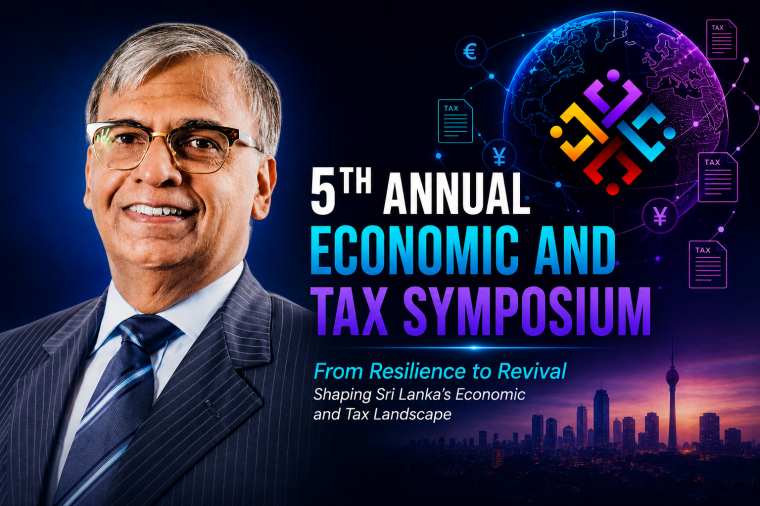
One of the most thought-provoking discussions at the 5th Annual Economic and Tax Symposium, organised by the Faculty of Taxation of the Institute of Chartered Accountants of Sri Lanka (CA Sri Lanka), came from Mr. N.R. Gajendran, Senior Partner of Gajma & Co., during the panel discussion titled "Enhancing Tax System Efficiency to Support Economic Growth."
Drawing on decades of experience as a tax practitioner, Mr. Gajendran argued that while Sri Lanka has made significant progress in improving tax revenue collection, sustainable economic growth requires much more than collecting higher taxes. A modern tax system, he noted, must be built on trust, certainty, fairness and efficient administration.
His presentation moved beyond technical tax provisions and focused on the broader relationship between the Government, taxpayers and investors. The following are the key insights shared during his presentation.
Sri Lanka's Biggest Deficit Is Not Fiscal—It Is Trust
Mr. Gajendran opened his presentation by observing that Sri Lanka has spent years analysing its economic problems. Policymakers understand the country's fiscal challenges, economists have proposed numerous solutions, and various roadmaps have been prepared to support economic recovery. Yet despite this collective knowledge, implementation has often failed to deliver the desired outcomes.
Using humour to illustrate a serious point, he remarked that while Sri Lanka frequently discusses fiscal deficits, current account deficits, budget deficits and foreign exchange shortages, the country's most critical deficit receives far less attention—the trust deficit.
According to him, rebuilding trust is fundamental to Sri Lanka's economic recovery. Investors must have confidence that government policies will remain reasonably stable, taxpayers must trust that they will be treated fairly, and businesses must believe that long-term investment decisions will not be undermined by sudden policy reversals.
Without restoring confidence, he argued, even the most attractive tax incentives and investment promotion strategies are unlikely to generate the level of investment the country needs.
Policy Stability Is More Valuable Than Attractive Tax Incentives
Mr. Gajendran emphasised that investors rarely make decisions based solely on tax rates or tax concessions. Instead, they evaluate whether the overall policy environment is predictable and reliable.
He pointed out that Sri Lanka has introduced several investment incentive schemes over the years. However, when incentives are subsequently withdrawn, amended or interpreted differently from their original intent, investor confidence suffers.
In his view, uncertainty discourages investment more than taxation itself.
Businesses planning investments over five, ten or even twenty years require assurance that the policy framework governing those investments will remain sufficiently stable. If investors fear that today's concessions may disappear tomorrow, many projects will simply not proceed.
For this reason, Mr. Gajendran argued that maintaining policy consistency is one of the strongest investment promotion tools available to any government.
The Tax Administration Should Differentiate Between Honest and Non-Compliant Taxpayers
One of the strongest messages delivered during the session related to the treatment of compliant taxpayers.
Mr. Gajendran questioned whether the Inland Revenue Department should continue allocating substantial audit resources towards taxpayers who have consistently demonstrated good compliance simply because they are already registered and easily accessible.
He described what he considers to be a "good taxpayer"—a taxpayer who files returns on time, pays taxes on time, maintains proper records and has no history of significant tax evasion.
Rather than repeatedly auditing such taxpayers, he suggested that they should receive greater administrative confidence. Revenue officers could then redirect their attention towards identifying businesses and individuals operating outside the tax system.
Such an approach, he argued, would encourage voluntary compliance while simultaneously broadening the country's tax base.
More importantly, compliant taxpayers would feel that their honesty is recognised rather than punished.
Broadening the Tax Base Should Be the Priority
Sri Lanka's recent improvements in tax revenue were also discussed during the panel.
While acknowledging the achievement of exceeding revenue targets, Mr. Gajendran questioned whether collecting more tax from the same taxpayers should automatically be considered a success.
He explained that sustainable revenue growth should ideally come from broadening the tax base rather than continually increasing the burden on those who already comply.
A narrow tax base forces governments to depend heavily on a relatively small number of taxpayers. Over time, this increases compliance costs, creates frustration among businesses and discourages investment.
Expanding the taxpayer base, on the other hand, distributes the tax burden more fairly while strengthening long-term revenue sustainability.
According to Mr. Gajendran, broadening the tax base should therefore remain one of Sri Lanka's highest priorities.
Over-Taxation Can Harm Long-Term Economic Growth
Mr. Gajendran also encouraged policymakers to consider the wider economic impact of taxation.
While tax revenue is essential for financing public expenditure, excessive taxation can reduce private sector activity if not carefully balanced.
Higher tax burdens reduce disposable income available for consumption, limit household savings and weaken the ability of businesses to reinvest profits. This ultimately affects productivity, employment creation and long-term economic growth.
He reminded the audience that taxpayers use their income for three primary purposes—consumption, savings and investment. When taxation significantly reduces these three activities, the economy itself begins to suffer.
For this reason, tax policy should seek an appropriate balance between revenue mobilisation and economic expansion.
Taxpayer Rights Should Receive Greater Attention
An interesting observation made during the discussion was that significant effort is devoted to expanding the tax base and strengthening tax enforcement, while comparatively little attention is given to taxpayer rights.
Mr. Gajendran questioned whether Sri Lanka should also begin discussing taxpayer protection with the same level of seriousness.
He argued that an efficient tax system should not measure success purely through revenue collection. It should also ensure fairness, transparency, consistency and respect for taxpayers.
Taxpayers who voluntarily comply with the law deserve efficient services, timely communication and reasonable certainty regarding their tax affairs.
Strengthening taxpayer rights, in his opinion, would further improve voluntary compliance by reinforcing public confidence in the tax system.
A Modern Tax System Requires an Efficient Refund Mechanism
Another practical issue raised by Mr. Gajendran related to tax refunds.
He observed that many businesses experience lengthy delays when claiming legitimate tax refunds. During periods of high interest rates, these delays effectively increase the financial cost of doing business.
According to him, requesting a refund should not automatically trigger suspicion or prolonged investigations.
Instead, an efficient refund system should be viewed as an essential feature of a modern revenue administration.
He argued that taxpayers who have paid excess taxes should receive timely refunds through efficient administrative procedures while risk-based audits can continue where genuine concerns exist.
A responsive refund system would not only improve taxpayer confidence but also demonstrate the professionalism of the tax administration.
Good Administration Is More Important Than More Legislation
Perhaps the most significant policy message from Mr. Gajendran's presentation was that Sri Lanka does not necessarily require more tax laws.
Instead, it requires better tax administration.
He observed that even well-designed legislation cannot achieve its intended objectives if administrative practices remain inconsistent, decision-making is delayed or taxpayers face unnecessary uncertainty.
Improving administrative efficiency, encouraging timely decision-making, simplifying procedures and promoting constructive engagement with taxpayers would produce greater long-term benefits than repeatedly introducing new legislative amendments.
Ultimately, he argued, tax administration is where government policy becomes reality.
A Shift in Mindset Is Equally Important
Throughout his presentation, Mr. Gajendran repeatedly returned to one underlying principle: relationships matter.
The relationship between taxpayers and the Inland Revenue Department should not be based solely on enforcement. Instead, it should be built on mutual trust, fairness and accountability.
He suggested that taxpayers should not be viewed merely as sources of government revenue but as partners in national development. Likewise, revenue authorities should be seen not simply as enforcement agencies but as institutions responsible for administering the tax system fairly and efficiently.
Changing this mindset, he suggested, may ultimately be one of the most important reforms Sri Lanka can undertake.
Conclusion
Mr. N.R. Gajendran's thoughts challenged the audience to look beyond tax rates and revenue targets. His message was that Sri Lanka's long-term economic success depends on building a tax system that earns the confidence of taxpayers, businesses and investors alike.
While improving revenue collection remains important, sustainable economic growth requires broader reforms that promote policy stability, strengthen taxpayer rights, improve administrative efficiency and encourage voluntary compliance.
As Sri Lanka continues its economic recovery journey, the issues raised during his presentation serve as a timely reminder that an effective tax system is not defined solely by the amount of revenue it collects, but by the level of trust it inspires among those who contribute to it.