From Compliance to Convenience: Dhanika Perera's Vision for a Citizen-Centric Digital Tax System
Jul 03, 2026 - 02:00 pm
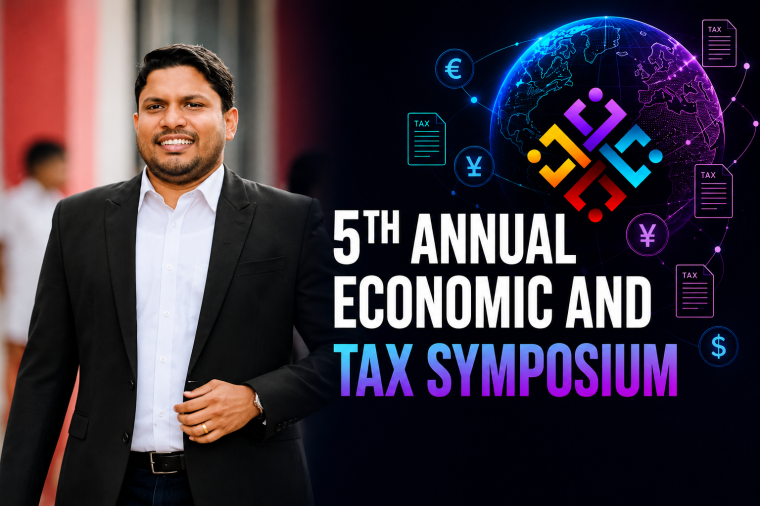
The panel discussion on "Enhancing Tax System Efficiency to Support Economic Growth" at the 5th Annual Economic and Tax Symposium, organised by the Faculty of Taxation of the Institute of Chartered Accountants of Sri Lanka (CA Sri Lanka) held on 02nd July 2026, brought together experts from taxation, corporate finance and technology to explore how Sri Lanka's tax system can better support sustainable economic growth.
Among the distinguished panellists was Mr. Dhanika Perera, Founder and CEO of Bhasha Lanka (PayHere), who shared a technology-driven perspective on the future of tax administration. Drawing on his experience in developing Sri Lanka's digital payment infrastructure, Mr. Perera discussed how digital transformation, system integration and artificial intelligence can simplify tax compliance, improve taxpayer services and strengthen revenue administration.
His remarks highlighted an important shift in thinking: the future of taxation should not merely focus on making government digital, but on making tax compliance simple, accessible and almost invisible to taxpayers.
Digital Transformation Must Focus on Citizens, Not Systems
During the discussion, Mr. Perera challenged the traditional understanding of digital transformation. In his view, digitalisation should not simply involve replacing paper forms with electronic versions or introducing more technology into government institutions. Instead, it should fundamentally improve the experience of citizens and businesses interacting with the tax system.
He explained that an efficient digital tax system should allow taxpayers to complete their obligations with minimal effort. Registration, return filing, tax payments and access to tax information should all be available through a single, user-friendly platform designed around the needs of citizens rather than the convenience of the tax authority.
According to Mr. Perera, many government digital systems are still developed primarily from an administrative perspective. While they may satisfy internal operational requirements, they often remain difficult for ordinary taxpayers to navigate independently.
He argued that a truly digital tax system should empower taxpayers by enabling them to fulfil their tax obligations confidently without depending excessively on intermediaries.
Simplifying Compliance Encourages Voluntary Tax Compliance
A recurring theme throughout Mr. Perera's contribution to the discussion was the close relationship between simplicity and voluntary compliance.
He observed that many people do not avoid tax because they are unwilling to comply. Instead, they often struggle because tax procedures are perceived as complicated and difficult to understand. Lengthy forms, technical terminology and fragmented systems create unnecessary barriers that discourage voluntary compliance.
Mr. Perera suggested that the future tax system should be intuitive enough for an ordinary citizen to register, submit tax returns and make tax payments independently using a mobile phone or personal computer.
If the compliance process becomes straightforward, taxpayers will view paying taxes as a routine civic responsibility rather than a burdensome administrative exercise.
He therefore stressed that digital transformation should focus not only on automation but also on simplification.
A Citizen-Centric Tax Portal Should Become the Foundation
One of the key ideas shared by Mr. Perera was the development of a comprehensive citizen-centric tax portal.
Rather than requiring taxpayers to interact with multiple disconnected systems, he envisaged a unified platform where individuals could:
- Register as taxpayers.
- Access their complete tax profile.
- Review taxes already paid.
- Submit tax returns electronically.
- Make tax payments securely.
- Monitor outstanding tax liabilities.
- Receive notifications and updates in real time.
Such a platform, he explained, would significantly improve the taxpayer experience while reducing administrative burdens for both taxpayers and the Inland Revenue Department.
More importantly, it would encourage greater self-compliance by making tax administration accessible to a much wider segment of society.
Digital Transformation Requires Process Simplification Before Technology
An important observation made by Mr. Perera was that technology alone cannot solve administrative inefficiencies.
Simply digitising an already complicated process often results in a digital version of the same problem.
Instead, he argued that government agencies should first examine existing procedures, eliminate unnecessary complexity and redesign workflows before introducing technology.
This principle has become one of the key lessons from successful digital transformation initiatives around the world. Digital systems create the greatest value when they simplify the user journey rather than merely automating outdated administrative processes.
For Sri Lanka's tax administration, this means reviewing taxpayer registration procedures, return filing requirements, approval processes and communication methods before introducing additional technological solutions.
Connecting Digital Platforms Is the Next Stage of Tax Administration
Mr. Perera also highlighted the importance of integrating the various digital platforms already used by businesses.
He noted that many businesses currently use accounting software, payment gateways, banking platforms and Point-of-Sale (POS) systems. However, these systems often operate independently without communicating directly with the Inland Revenue Department.
Rather than requiring businesses to adopt entirely new software, he proposed an Open API approach whereby existing commercial systems could securely exchange relevant tax information with the Inland Revenue Department in real time.
According to Mr. Perera, such integration would:
- Eliminate duplicate data entry.
- Reduce manual errors.
- Improve the accuracy of tax reporting.
- Simplify compliance for businesses.
- Strengthen real-time monitoring by the tax authority.
Ultimately, tax reporting should become a seamless by-product of normal business operations rather than an additional administrative burden.
Artificial Intelligence Can Transform Taxpayer Services
Artificial Intelligence (AI) featured prominently in Mr. Perera's discussion on the future of tax administration.
He explained that AI should not be viewed solely as a compliance or enforcement tool. Instead, it has enormous potential to improve taxpayer services.
AI-powered virtual assistants could provide taxpayers with immediate guidance on registration, filing obligations, payment procedures and general tax queries around the clock.
Such systems would significantly reduce waiting times while allowing Inland Revenue officers to focus on more complex technical matters requiring professional judgement.
Mr. Perera also noted that AI can strengthen compliance through advanced data analysis by identifying unusual transaction patterns, detecting anomalies, supporting risk-based audit selection and improving decision-making through predictive analytics.
Many modern tax administrations around the world are already adopting these technologies to improve efficiency while reducing administrative costs.
Technology Is Not the Biggest Challenge—Mindset Is
Perhaps one of the most insightful observations shared by Mr. Perera was that Sri Lanka's greatest obstacle is often not technology but institutional mindset.
Drawing on his experience in building PayHere, he explained how financial institutions initially insisted on receiving physical documents even though electronic documentation was already legally recognised.
Only during the COVID-19 pandemic did fully digital onboarding become widely accepted out of necessity.
This experience demonstrated that the technological capability already existed. The real challenge was changing long-established administrative practices and building confidence in digital processes.
According to Mr. Perera, similar mindset changes are still required within many public sector institutions if Sri Lanka is to fully realise the benefits of digital government.
The Electronic Transactions Act Already Provides a Strong Legal Foundation
Mr. Perera also reminded the audience that Sri Lanka already has a strong legal framework supporting digital transactions.
The Electronic Transactions Act recognises electronic records and digital documents as legally valid in many circumstances. Despite this legal recognition, many organisations continue requesting printed copies alongside electronic submissions.
He suggested that government agencies, financial institutions and businesses should place greater confidence in digital documentation and redesign administrative procedures accordingly.
Fully embracing the legal recognition already available under existing legislation would reduce paperwork, improve efficiency and significantly enhance the taxpayer experience.
Building Trust Through Better Digital Experiences
Although Mr. Perera's remarks centred on technology, they also reinforced one of the broader themes discussed throughout the panel.
Technology alone does not build trust.
Trust is created when digital systems are reliable, user-friendly, transparent and responsive to the needs of citizens.
A taxpayer who can easily register, obtain information, submit returns and resolve issues through intuitive digital platforms is more likely to view the tax administration as a service-oriented institution rather than merely an enforcement authority.
Digital transformation therefore becomes not only an efficiency initiative but also an opportunity to strengthen voluntary compliance and improve public confidence in the tax system.
Conclusion
During the panel discussion, Mr. Danika Perera shared a compelling vision for the future of Sri Lanka's tax administration—one where technology simplifies compliance rather than complicating it.
His insights extended beyond introducing new software or artificial intelligence tools. Instead, they focused on redesigning tax administration around the needs of citizens, simplifying compliance, integrating digital ecosystems and making better use of technologies already supported by Sri Lanka's legal framework.
As Sri Lanka continues its digital transformation journey, the ideas shared by Mr. Perera demonstrate that the future of taxation is not simply about becoming digital. It is about creating a tax administration that is simple, connected, citizen-centric and trusted.
His contribution to the discussion highlighted that successful tax reform depends not only on legislative amendments and administrative reforms but also on leveraging technology to improve taxpayer experience, strengthen voluntary compliance and support sustainable economic growth.