Enhancing Tax System Efficiency to Support Economic Growth: Key Insights from the 5th Symposium
Jul 02, 2026 - 05:00 pm
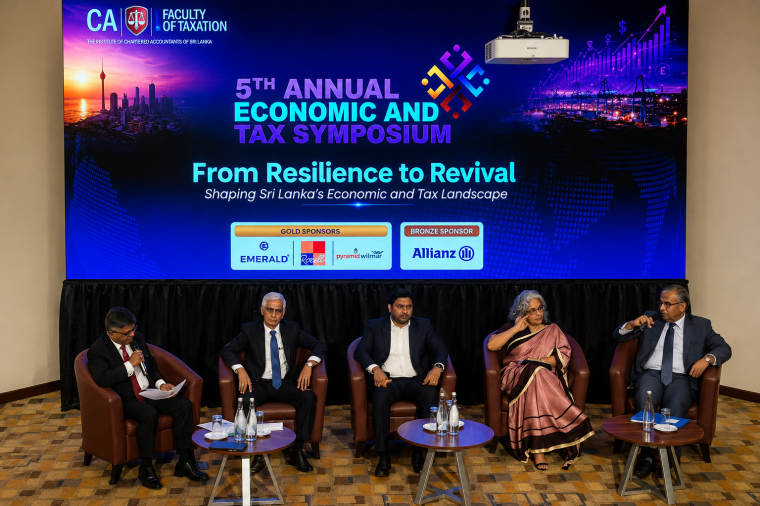
The 5th Tax Symposium, organized by the Faculty of Taxation of the Institute of Chartered Accountants of Sri Lanka (CA Sri Lanka), featured an insightful panel discussion on "Enhancing Tax System Efficiency to Support Economic Growth." The session was moderated by Mr. Saman Sri Lal, Chairman of the Faculty of Taxation, and brought together distinguished experts from the fields of taxation, corporate finance and digital technology.
The panel consisted of:
- Mr. N.R. Gajendran – Senior Partner, Gajma & Co.
- Ms. Nisreen Rehmanjee – Head of Corporate Structuring, Strategic Tax and Social Entrepreneurship, John Keells Group
- Mr. Danika Perera – Founder & CEO, Bhasha Lanka (PayHere)
- Mr. Athula Ranaweera – Managing Partner, Ranaweera Associates
The discussion explored how Sri Lanka can create a more efficient tax system that not only improves revenue collection but also strengthens investor confidence, voluntary compliance and long-term economic growth.
Key Insights Shared by Mr. N.R. Gajendran
Mr. N.R. Gajendran argued that Sri Lanka's greatest challenge is not its fiscal deficit but its trust deficit. He explained that while the country has already identified many of its economic problems and proposed numerous solutions, implementation continues to suffer because investors and taxpayers lack confidence in the stability of government policies.
He stressed that trust is fundamental to attracting investment. Frequent policy changes, the withdrawal of previously announced tax incentives and inconsistent administrative practices discourage both local and foreign investors. According to him, restoring confidence should become a national priority if Sri Lanka hopes to attract sustainable investment.
Another major concern raised by Mr. Gajendran was the treatment of compliant taxpayers. He questioned whether taxpayers who consistently file returns, pay taxes on time and maintain good compliance records should continue to face repeated audits simply because they are easy to monitor. Instead, he advocated expanding the tax base by identifying new taxpayers rather than placing increasing pressure on those who already comply.
He also highlighted the importance of efficient tax refund mechanisms, arguing that delayed refunds undermine confidence in the tax system and unnecessarily burden businesses. More broadly, he observed that Sri Lanka requires improvements in tax administration rather than constant legislative changes, emphasising that fair treatment, efficient administration and taxpayer rights are essential components of a modern tax system.
Key Insights Shared by Ms. Nisreen Rehmanjee
Speaking from the perspective of corporate investors, Ms. Nisreen Rehmanjee emphasised that businesses are not primarily seeking tax concessions; rather, they seek tax certainty. Investors making long-term investment decisions require confidence that tax laws and administrative practices will remain predictable throughout the life of their projects.
She explained that frequent changes in tax legislation and inconsistent interpretations create uncertainty, making it difficult for businesses to prepare reliable financial projections and investment models. This uncertainty often discourages investment even where commercial opportunities exist.
Ms. Rehmanjee also highlighted the importance of maintaining a clear distinction between tax policy and tax administration. While policymakers should determine the country's tax framework, tax administrators should focus on implementing those policies consistently rather than effectively shaping policy through administrative interpretations.
She further recommended stronger consultation between government and the private sector before tax legislation is enacted. According to her, involving businesses and professional bodies during the drafting process would reduce practical difficulties, minimise future disputes and produce legislation that better reflects economic realities. Greater transparency through the publication of administrative rulings, accepted court decisions and official interpretations would also significantly improve taxpayer certainty.
Key Insights Shared by Mr. Danika Perera
Mr. Danika Perera focused on the role of digital transformation in creating a more efficient and user-friendly tax system. He explained that digitalisation should not simply involve replacing manual processes with electronic systems; instead, it should fundamentally redesign tax administration around the needs of citizens and businesses.
He proposed the development of a truly citizen-centric tax portal where taxpayers could easily register, file returns, make payments and access their tax information without depending heavily on intermediaries. Simplifying tax compliance, he noted, would naturally encourage greater voluntary compliance.
Mr. Perera also discussed the importance of integrating payment gateways, banking systems and point-of-sale (POS) platforms with Inland Revenue systems through open APIs. Such integration would enable real-time reporting while reducing duplication of work for businesses.
Artificial Intelligence was another important topic. He explained that AI could significantly enhance customer service through 24-hour taxpayer assistance while also strengthening compliance by analysing data, identifying anomalies and supporting risk-based audits. Drawing on his experience with PayHere, he observed that Sri Lanka's biggest challenge is often not technology itself but the mindset that continues to favour paper-based processes despite the legal recognition of digital documentation under the Electronic Transactions Act.
Key Insights Shared by Mr. Athula Ranaweera
Mr. Athula Ranaweera highlighted tax education as one of the most important factors in improving voluntary compliance. He argued that many taxpayers are not deliberate tax evaders but rather individuals who struggle because they lack sufficient knowledge of increasingly complex tax laws.
In his view, education should begin with tax administrators themselves. Inland Revenue officers require not only stronger technical knowledge but also better practical understanding of how tax laws operate in real business situations. Consistent interpretation of tax legislation and improved taxpayer handling would significantly strengthen public confidence.
Mr. Ranaweera also stressed the responsibility of the Inland Revenue Department, professional bodies and tax practitioners to educate taxpayers through seminars, digital platforms and awareness programmes. A better-informed taxpayer community, combined with a well-trained tax administration, would contribute significantly to improving compliance while reducing unnecessary disputes.
Conclusion
Although each panellist approached the subject from a different professional background, a common message emerged throughout the discussion. Sri Lanka's future tax reforms should not be measured solely by higher revenue collection. Long-term success will depend on building trust, providing policy certainty, modernising digital services, strengthening tax administration and investing in taxpayer education.
The discussion demonstrated that an efficient tax system is not simply one that collects more revenue, but one that encourages voluntary compliance, supports investment, treats taxpayers fairly and contributes to sustainable economic growth. These principles will be essential if Sri Lanka is to build a tax system capable of supporting its long-term economic aspirations.