How to Obtain a Tax Residency Certificate (TRC) in Sri Lanka

Are you a Sri Lankan tax resident earning income from overseas? You may be eligible to claim tax relief under a Double Taxation Avoidance Agreement (DTAA) between Sri Lanka and the relevant foreign country.
To claim such benefits, you may need to obtain a Tax Residency Certificate (TRC) issued by the Inland Revenue Department (IRD) of Sri Lanka.
The IRD has issued an official notice explaining the procedure for obtaining a TRC, including eligibility requirements, supporting documents and the application process.
1. What Is a Tax Residency Certificate?
A Tax Residency Certificate is an official document issued by the IRD confirming that a taxpayer is considered a tax resident of Sri Lanka.
This certificate is particularly important for individuals and businesses receiving income from foreign countries, as it may help them claim benefits available under applicable Double Taxation Avoidance Agreements.
For example, a Sri Lankan resident providing consultancy services to a foreign company may be requested to submit a TRC to the foreign tax authority or payer to support a claim for treaty benefits.
However, obtaining a TRC does not automatically exempt foreign income from taxation. The actual tax treatment depends on the relevant DTAA and applicable tax laws.
2. Who Can Apply for a TRC?
According to the IRD notice, the following categories of resident taxpayers may apply:
-
Individuals
-
Companies
-
Partnerships
A taxpayer may require a TRC to claim DTAA benefits or satisfy tax-related requirements imposed by another country.
3. How to Apply for a TRC
The application must be submitted using the prescribed form issued by the Inland Revenue Department.
The completed application, together with the relevant supporting documents, should be submitted electronically to the International Tax Affairs Unit.
Email: itp@ird.gov.lk
The application form is available through the official IRD website.
4. Documents Required
The IRD notice identifies several documents that may be required, including:
-
Completed TRC application form
-
Previously issued TRC, if applicable
-
Request from a foreign tax authority or payer, if applicable
-
Certificate of Incorporation or Business Registration, where relevant
Additional requirements for individuals:
Individual applicants must provide scanned copies of their National Identity Card, passport bio-page, visa pages and passport pages showing arrival and departure stamps.
These documents help the IRD assess the applicant's tax residency status.
5. Important Requirements Before Applying
Before submitting the application, taxpayers are advised to ensure that their information in the Revenue Administration Management Information System (RAMIS) is accurate and updated.
Particular attention should be given to:
-
Current residential or registered address
-
Nature of business activities, where applicable
-
Taxpayer Identification Number (TIN) and taxpayer profile
-
Submission of applicable tax returns, statements and tax payments
The IRD may request additional information or documentation to determine the applicant's tax residence status.
6. Validity and Application Deadline
The IRD has clarified that there is no specific deadline for submitting a TRC application. Taxpayers may apply whenever the certificate is required.
However, a TRC is valid for 12 months from the date of issuance.
Therefore, taxpayers receiving foreign income should consider the timing of their applications, particularly when foreign tax authorities or payers request valid residency certification.
Why Is This Important?
With more Sri Lankan professionals, consultants, freelancers and businesses earning income internationally, understanding the TRC application process has become increasingly important.
A TRC can help eligible taxpayers access treaty benefits, potentially reducing double taxation and supporting compliance with foreign tax requirements.
Before applying for a TRC, ensure that your tax records are updated and verify whether Sri Lanka has an applicable DTAA with the country from which you receive income.
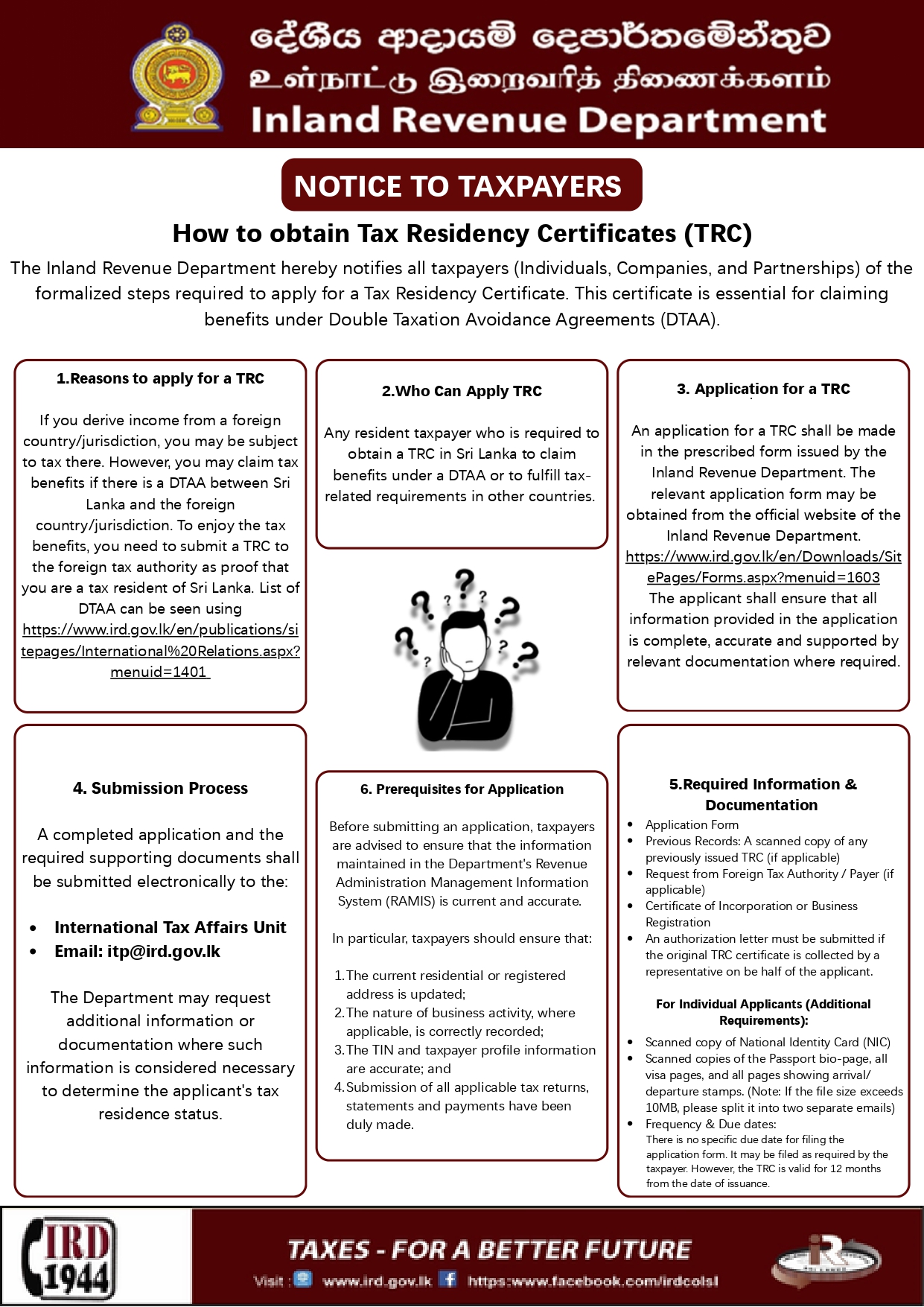
For further information, please carefully go through the official IRD notice in the image below, which explains the application procedure, documentation requirements and other important conditions.