From Crisis to Confidence: Key Insights from the 27th Annual Tax Oration of CA Sri Lanka
(A Participant Report by TaxAdvisor.lk)
The CA Sri Lanka Annual Tax Oration is a significant professional event organised by the Institute of Chartered Accountants of Sri Lanka (CA Sri Lanka) through its Faculty of Taxation, which was established in 1995 to enhance knowledge and professional practice in taxation. The oration attracts tax professionals and senior policymakers to deliberate on contemporary tax and economic policy issues. The orator is awarded a medallion sponsored by Mr. Esmond Satarasinghe, a founding member of the first CA Sri Lanka Council.
At the commencement of the event, Ms. Sarah Afker, Chairperson of the Faculty of Taxation of CA Sri Lanka, outlined the history of the Annual Tax Oration, noting that the series has been conducted from inception to date, with contributions from many distinguished professionals and policymakers. She highlighted the role of the Tax Oration in shaping tax and economic policy discourse in Sri Lanka and noted that the 27th Annual Tax Oration was the final Faculty of Taxation event for the year, conducted under her leadership.
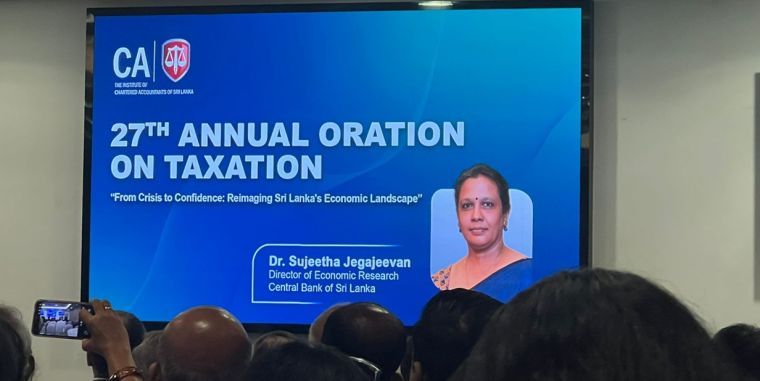
This article is prepared as a participant report by TaxAdvisor.lk, summarising key points presented at the 27th Annual Tax Oration, held on 16 December 2025. The oration was delivered by Dr. Sujeetha Jegajeevan, Director of Economic Research at the Central Bank of Sri Lanka, under the theme “From Crisis to Confidence: Reimagining Sri Lanka’s Economic Landscape.”
Why Sri Lanka Needed Faster Economic Growth
The oration identified several challenges and risks that explain why Sri Lanka must achieve stronger and sustained economic growth:
-
Persistent low economic growth, challenging macroeconomic stability
-
Reform fatigue, weakening acceptance of corrective measures
-
Risk of falling into a middle-income trap
-
Demographic challenges, including an ageing population
-
Global geopolitical and economic policy uncertainties
-
Increasing climate-related risks
Growth-Enhancing Strategies: Near to Medium Term
The following growth-enhancing strategies were highlighted for the near to medium term:
-
Promotion of tourism and other service sectors with high potential
-
Increasing female labour force participation
-
Digitalisation and adoption of artificial intelligence
-
Improving trade openness, facilitation, promotion, and diversification
-
Improving the doing business environment and investment climate
-
Private sector–led growth with limited state intervention
-
Productivity improvements across the economy
Why Sri Lanka Entered the IMF Programme for the 17th Time (2023)
The oration explained that Sri Lanka’s 17th IMF programme in 2023 was the result of long-standing structural weaknesses, rather than a single economic shock. It was noted that similar challenges existed during Sri Lanka’s first IMF programme in 1965, and that the current programme is built broadly on similar policy pillars, though under more severe economic conditions.
Key contributing factors identified:
-
Chronic balance of payments deficit
-
Depleted foreign exchange reserves
-
Large budget deficits
-
Monetary expansion
-
Slow economic growth
-
Subsidisation of government enterprises
Policy focus areas under IMF programmes:
-
Fiscal consolidation
-
Prudent macroeconomic management
-
External sector stability
-
Foreign exchange management
Policy Measures Implemented to Contain the Crisis
The following policy measures implemented by the Government were outlined:
-
IMF Programme – Initiation of negotiations for a macroeconomic stabilisation programme, with support from the World Bank and ADB
-
External Debt Standstill – Suspension of selected foreign debt service payments and initiation of the debt restructuring process
-
Fiscal Reforms – Introduction of a revenue-based fiscal consolidation package, including tax reforms
-
Restrictions on Forex – Imposition and intensification of restrictions on selected non-essential imports
-
Cost-Recovery Pricing – Frequent adjustments to utility prices to reflect cost structures
Strengthening the Institutional Framework: Monetary Policy
The oration highlighted the Central Bank of Sri Lanka Act, No. 16 of 2023 as a key reform in strengthening monetary policy discipline.
Key features highlighted:
-
Prohibition on monetary financing
-
Central Bank Boards excluding the Secretary to the Treasury
-
Enhanced autonomy of the Central Bank
-
Increased public accountability
-
Legal recognition of the Flexible Inflation Targeting Framework
Strengthening the Institutional Framework: Fiscal Policy
On fiscal policy, reference was made to the Public Financial Management Act, No. 44 of 2024, which aims to strengthen fiscal discipline.
Key objectives highlighted:
-
Ensuring discipline, transparency, and accountability in fiscal management
-
Improving medium-term fiscal planning and reporting
-
Ensuring that public debt is reduced to and maintained at sustainable levels
-
Managing and mitigating fiscal risks
-
Creating and maintaining fiscal buffers against future shocks
-
Facilitating effective scrutiny of fiscal performance
International Experiences Highlighted
International examples were cited to demonstrate successful crisis resolution through consistent reform implementation:
-
India (1991) – Fiscal consolidation, trade liberalisation, and exchange-rate reforms
-
South Korea (1997) – Financial sector restructuring, trade and investment liberalisation, and governance reforms
-
Ireland (2008–2010) – Fiscal consolidation and banking sector restructuring
-
Jamaica (late 2000s) – Debt restructuring, strong fiscal rules, and sustained IMF engagement
A key message was that while reforms differed across countries, continued commitment to reform implementation was the decisive factor behind success.
Lessons from Crisis Management
The oration highlighted the following lessons from crisis management:
-
Macroeconomic fundamentals cannot be compromised over long periods
-
Quick fixes to economic problems are short-lived
-
Delayed corrective action increases economic costs
-
Crisis responses must be well coordinated across policy areas
-
External support frameworks help enforce policy discipline
-
Governance and accountability must be prioritised
-
Economic crises disproportionately affect vulnerable segments of society, causing long-term scarring
Conclusion
The 27th Annual Tax Oration highlighted that Sri Lanka’s transition from crisis to confidence depends on sustained reform implementation, strong institutional frameworks, and consistent economic policy execution. The Central Bank of Sri Lanka Act and the Public Financial Management Act were presented as critical reforms aimed at preventing a recurrence of similar crises and supporting long-term macroeconomic stability.
27th Annual Tax Oration – CA Sri Lanka
Orator: Dr. Sujeetha Jegajeevan
Designation: Director of Economic Research, Central Bank of Sri Lanka
Source: Participant report prepared by TaxAdvisor.lk